ISO 9001, ISO 14001, ISO 45001 und IECQ QC080000
 Über 15 Jahre Erfahrung
 KOSTENLOSE Muster zur Sicherstellung der Produktzufriedenheit
 Schnelle Abwicklung: Massenproduktion in 15 - 20 Tagen abgeschlossen

Two names surface more than most when a buyer shortlists custom pogo pin manufacturers in southern China. One is CFE Conn, a Dongguan connector maker with a broad interconnect range. The other is Promax Pogo-Pin, a Dongguan factory that specializes exclusively in spring-loaded contacts. Both companies read alike on a supplier list but behave differently once a project starts.
This comparison sets the two side by side across six dimensions: manufacturing base, minimum orders, plating, lead time, certifications, and project fit. Every claim about either company comes from public documentation. Engineers already scoping a build can work back from the custom pogo pin connector range to the supplier question.
How Did We Compare These Two Manufacturers?
Everything said here about CFE Conn comes from their own published material. Where they have not published something, this article says so and marks it. Contact for details rather than filling the gap with a guess. The same standard applies for Promax Pogo Pin.
Six dimensions carry it, in order: manufacturing base and specialization, minimum order and sample policy, plating and material breadth, lead time, certifications and agreements, then typical use-case fit. Those are the questions a sourcing engineer works through before a first sample lands.
One note on figures. Connector performance moves with part design, so numbers appear once, with their conditions attached.
CFE Conn vs. Promax at a Glance
The table below sets the two companies against the facts a shortlist actually turns on. It carries identity and status rather than performance figures, as those depend on the part and appear in the sections below. One is a broad interconnect manufacturer with quality systems built for regulated supply chains. The other is a single-family specialist with published turnaround commitments.
| Dimension | CFE Conn | Promax Pogo-Pin |
|---|---|---|
| Headquarters | Changan, Dongguan, Guangdong | Changan, Dongguan, Guangdong, plus a US office in Gary, Indiana |
| Founded | 2009 | 2014 |
| Ownership | Subsidiary of CFE Corporation | Independent, with a precision sub-company formed in 2019 |
| Core focus | Spring-loaded contacts alongside magnetic connectors, cables, stamping, and module assembly | Spring-loaded contacts, magnetic connectors, and test probes |
| Contact technologies | Pogo pin, claw, crown, and wire | Pogo pin, magnetic connector, and spring-loaded test probe families |
| Custom design route | Engineering-led custom service, published without response intervals | Engineering feedback within 1–3 days |
| Minimum order and samples | Contact for details | Free samples, no prototype minimum |
| Lead time transparency | Contact for details | Published intervals, see the lead time section |
| Quality systems | ISO 9001, 14001, 13485, IATF 16949, IECQ QC080000, plus an ISO 17025-accredited lab | ISO 9001, 14001, 45001, IECQ QC080000 |
| NDA and NCA policy | Contact for details | Signed on request |
| Patents claimed | 200+ | 22+ |
| Suits buyers who need | Medical or automotive quality-system coverage, in-house test accreditation, or one-stop module assembly | Deep pogo pin customization, fast design turnaround, and direct factory pricing |
Where Does Each Manufacturer Build, and What Do They Specialize In?

Specialization is a trade rather than a virtue. A broad manufacturer gives you one purchase order, one quality agreement, and one contact across several component types. A narrow one gives you a factory where every engineering hour went into a single product family. You pay for whichever one you leave behind.
Both companies build in Changan, Dongguan, a few miles apart. Buyers weighing China direct sourcing rarely notice that the two names on their shortlist come from the same town.
What CFE Conn builds
CFE Conn works across four contact technologies: pogo pin, claw, crown, and wire. Around those sit magnetic connectors, connecting cables, precision stamping, and assembled modules. Their published pogo pin range runs 5A–30A, and they date their first 30A pin to 2010.
That high-current heritage is real and worth conceding plainly. For a buyer who wants pins, a cable, and a housed module on one purchase order, breadth is the answer. No amount of specialization substitutes for it.
What Promax builds
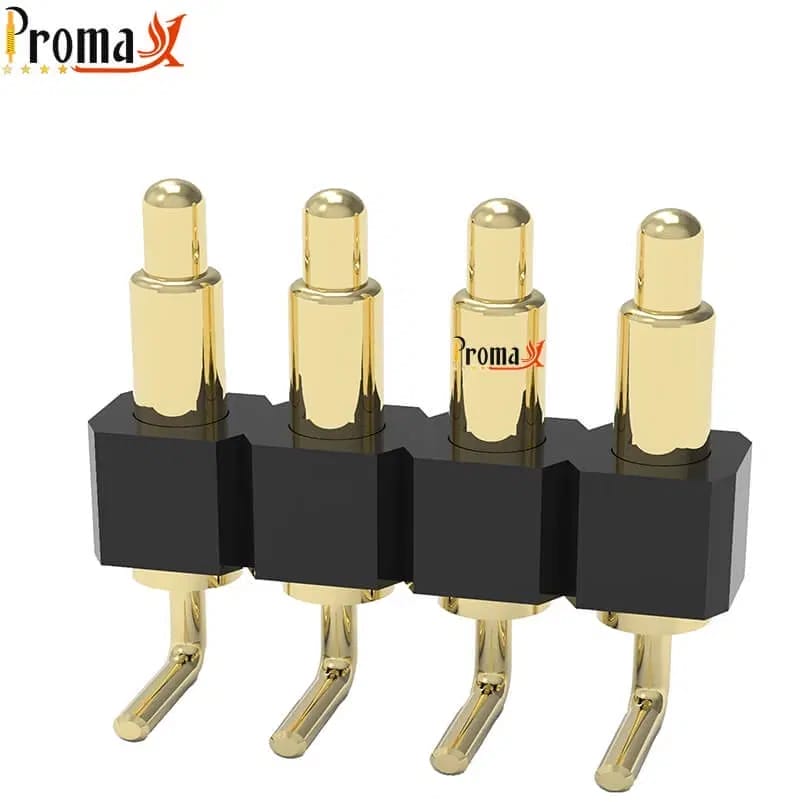
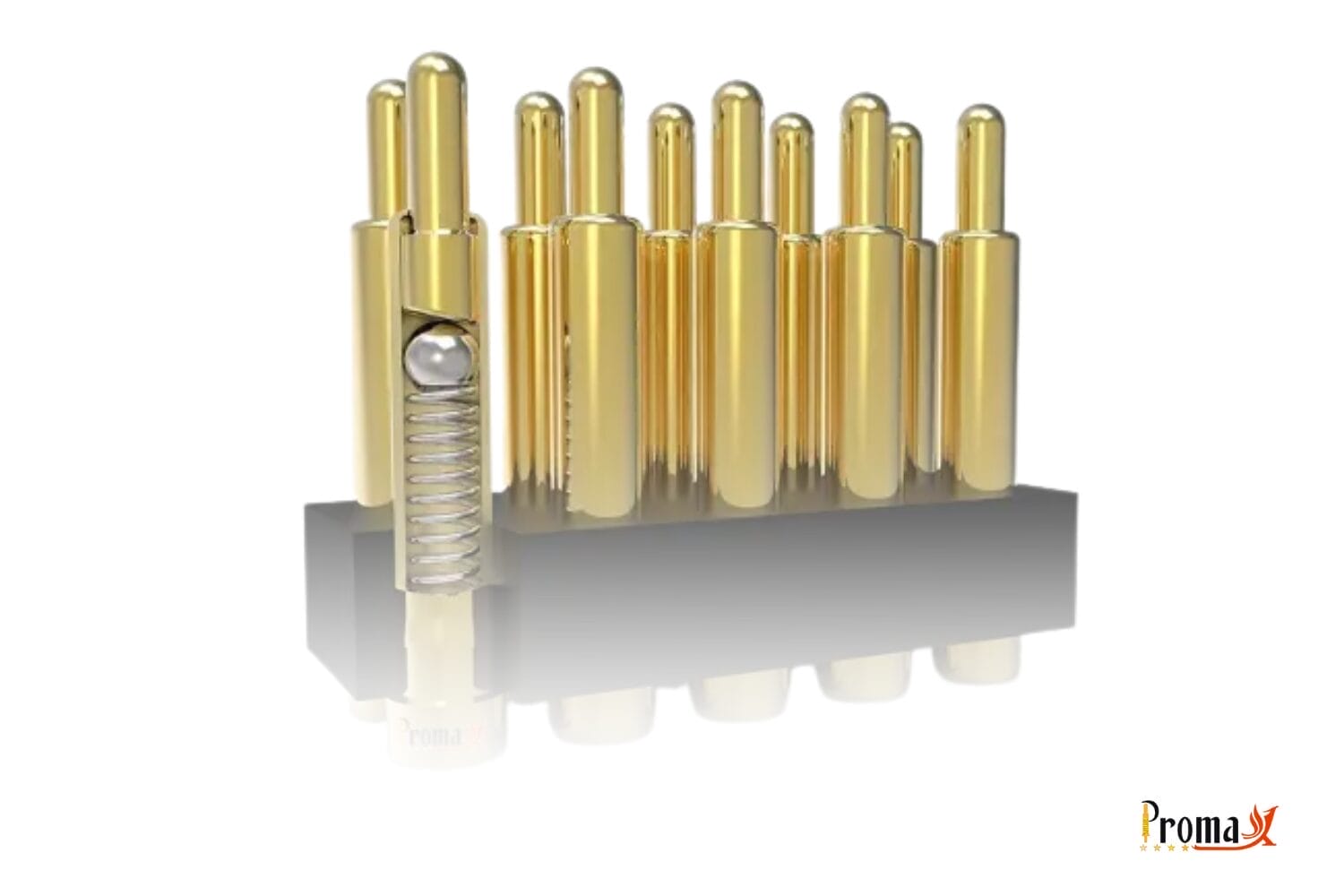
Promax builds one connector family. Pogo pins come in surface mount, through-hole, right angle, double-ended, bending type, and solder cup formats. Magnetic connectors and test probes sit alongside them. Production runs from a 15,000 m² facility in Dongguan with 300+ employees, including 20+ engineers.
Custom ratings reach 40A and 120V, though what any single pin achieves depends on its diameter, its material, and the part design around it. Those are ceilings for the range, not datasheet values for every part.
Breadth means one purchase order. Focus means the expert engineering hours all went to one place. Neither answer helps until you know which of those your program actually needs.
What Should You Expect on Minimum Orders and Samples?
The sample stage decides more shortlists than any spec sheet does. A supplier who makes qualification cheap and quick tends to get qualified, as the engineering team can test a real part before anyone commits budget.
CFE Conn has not published minimum order quantities, a sample policy, or sample costs. Their public material covers products and capabilities rather than commercial terms. Contact for details is the honest entry here, and an unpublished policy is not a bad policy. Plenty of manufacturers quote a minimum per configuration and keep it off their website.
Promax publishes free samples for qualification with no minimum order quantity at the prototype stage. Production minimums still depend on the pin design and the tooling behind it. The practical difference is not really cost — it is how early you get to hold your part.
Ask both suppliers the same four questions before making a decision:
- What does a first sample cost, and what does it cost to revise it once?
- What is the production minimum for this specific pin design, not for a standard part?
- Who pays for tooling, and who owns it afterward?
- How long from design approval to first sample on my bench?
How Far Does Each Company Go on Plating and Materials?
A plating stack does two jobs at once. It keeps contact stable where the tip meets the pad, and it survives the wear that comes with mating cycles. Base metal sits underneath that decision. Brass and Beryllium Copper behave differently under load, and spring material changes the force curve across travel.
No stack wins everywhere. Gold over Nickel is common where cycles run high and the environment stays mild. Thicker Gold buys wear life and costs more. A sealed outdoor product and a desk charging dock want different answers from the same material family.
Both companies publish material and plating options, and both offer custom finishes. Neither publishes a thickness table you can specify from directly, so treat the published options as a starting point and confirm the detail with either supplier.
What holds a production run together is the complete system. Alignment tolerance, spring travel, plating consistency, and assembly discipline have to hold together across thousands of parts. Precision in a connector is the outcome of those four working as one, not a property of any single component. Ask either supplier what varies batch to batch, because that answer tells you more than any dimension on a drawing.
Brauchen Sie schnell Pogo-Pins? Sprich mit einem Ingenieur
Erhalten Sie ein individuelles Angebot, passende Spezifikationen und Fertigungsberatung – ohne Ihr Projekt zu verlangsamen.
- ISO 9001 / 14001 / 45001 + IECQ QC080000
- Über 15 Jahre Erfahrung
- Kostenlose Muster
- Serienfertigung in 15–20 Tagen
How Long Until Parts Reach Your Bench?
A slipped sample date moves a launch date—that is why lead time belongs in a supplier comparison rather than in a footnote. A connector holds up a whole build when it lands late.
Promax publishes an interval for each stage. Engineering feedback on a design request comes back within 1–3 days. Samples ship in around two weeks. Mass production runs 3–4 weeks from tooling approval.
CFE Conn has not published equivalent intervals. Design response, sample delivery, and production timing are absent from their public pages. Confirm these figures with their sales team before building a schedule.
Worth saying plainly: published intervals are commitments, not guarantees on every part. A complex tool or an unusual plating stack moves them. A supplier quoting the same interval regardless of what you send them is quoting a marketing number.
Which Certifications and Agreements Cover Your Project?
Certifications decide whether a supplier qualification form gets signed. A missing standard is not negotiable when a regulated program has to show auditors a compliant chain. Connector test practice itself sits under the IEC 60512 series, which frames how contact performance gets measured.
CFE Conn holds the stronger certification stack here. They publish ISO 9001, ISO 14001, ISO 13485 (medical device quality management), IATF 16949 (automotive supply chain), and IECQ QC080000. They also run an in-house validation lab accredited to ISO 17025 under CNAS. For a program that needs either medical or automotive coverage, that stack is a genuine advantage. The accredited lab means test data arrives from a recognized system.
Promax holds ISO 9001, ISO 14001, ISO 45001, and IECQ QC080000, covering quality, environment, safety, and hazardous substance management. Mass production yield sits above 99%, and that figure describes a system rather than a part. The plating line, assembly, and inspection have to hold together across a run for it to mean anything.
Procurement usually raises a second category of paperwork in the same conversation. Promax signs non-disclosure and non-circumvention agreements on request. CFE Conn has not published a policy on either—confirm directly with their team. A similar certification split runs through our CCP Contact Probes comparison if you want another reference point.
Which Projects Suit Each Manufacturer?
Fit is easier to judge from the project than from the company. Three shapes point toward CFE Conn, and two point toward Promax.
Projects that suit CFE Conn
Test-intensive regulated work is the clearest fit. A program filing validation data benefits from a supplier whose lab carries ISO 17025 accreditation, as the reports arrive in a form auditors already accept.
Assembly-level sourcing is the second. If your bill of materials needs pins, a cable, and a housed module, one manufacturer removes an interface and a supplier audit.
Miniature designs are the third. CFE Conn states micro spring pins from 0.5 mm in diameter and 2 mm in height. That claim is published on their own site rather than verified here. Where board space rules the design, it is worth a direct conversation.
Projects that suit Promax
Programs that design a pin rather than select one sit at the center of the range. When a footprint, a stroke length, or a mating format has no catalog equivalent, catalogs stop helping.
An engineering team working only on spring contacts iterates faster than one splitting attention across families. An engineering team that has spent over a decade on one product family builds up a depth of process knowledge that generalist manufacturers simply can’t match.
Promax Pogo Pin has delivered 8,000+ custom designs across consumer, medical, automotive, and aerospace programs. This record is evidence that the range holds outside standard parts.
Direct factory work is the second profile. Buying from the factory removes an intermediary margin and puts questions directly in front of the engineers who build the part.
When to Choose Promax
Four factors tip a shortlist toward Promax.
Iteration speed comes first. Published design response and free samples mean every revision loop is shorter, from the first drawing to a qualified part on your bench. That matters most when the design is still moving.
Cost structure comes second. Buying directly from the factory removes intermediary margin. On a program where connector cost is a real line in the bill of materials, that difference compounds across volume.
Custom pin designs come third. When a footprint, stroke length, or current requirement has no catalog answer, a factory that builds nothing but pins is the right call. Every engineering hour at Promax went into spring-loaded contacts, and it shows in what they can hold on a custom drawing.
The fourth is specialization depth. Where pogo pin performance is the primary variable in your program, choose the specialist. CFE Conn is the stronger call where medical or automotive certification paperwork drives the shortlist, but where the pin itself is what the design hangs on, Promax is the answer.
Send us the drawing or the project requirements. Our engineers come back with a design assessment within 1–3 days, a material and plating recommendation matched to your application, and free samples so you can qualify a real part before any tooling commitment.
FAQs on CFE Conn vs Promax
Is CFE Conn a manufacturer or a trading company?
CFE Conn is a manufacturer. The company runs its own facility in Changan, Dongguan, and produces spring-loaded contacts, magnetic connectors, cables, and assembled modules. Their published material describes in-house design, tooling, and production rather than sourcing from other factories.
Can both manufacturers supply magnetic connectors?
Both publish magnetic connector lines. Pin counts, mating formats, and cable options differ between the two ranges, so match the configuration to your dock rather than assuming parity. Ask for a mating drawing early—the housing sets the footprint.
How long does qualifying a new pogo pin supplier usually take?
Qualification runs as a full cycle: design review, samples, lifecycle testing, pilot build, and first article inspection. Published sample intervals shorten the front end only. Your own test plan usually sets the total length, so start it before tooling money moves.
Do I need ISO 13485 certification for a medical device connector?
It depends on your own quality system and what your notified body expects of component suppliers. Some programs accept a supplier certified to ISO 9001 with documented process controls. Where ISO 13485 is mandatory, it narrows a shortlist immediately—establish that requirement before evaluating anyone.
Which one is cheaper per unit?
Neither company publishes unit pricing. Cost tracks pin design, plating stack, order volume, and tooling, so a quote against your own drawing is the only real answer. Send both suppliers the same drawing and compare the whole package, with tooling included.
Can I move a design between the two later?
Custom pogo pins are rarely interchangeable between manufacturers. Tooling, achievable tolerances, and mating pad expectations differ, so plan a requalification if you switch.
Zurück nach oben CFE Conn vs Promax: Pogo Pin Connector Comparison
Brauchen Sie schnell Pogo-Pins? Sprich mit einem Ingenieur
Erhalten Sie ein individuelles Angebot, passende Spezifikationen und Fertigungsberatung – ohne Ihr Projekt zu verlangsamen.
- ISO 9001 / 14001 / 45001 + IECQ QC080000
- Über 15 Jahre Erfahrung
- Kostenlose Muster
- Serienfertigung in 15–20 Tagen