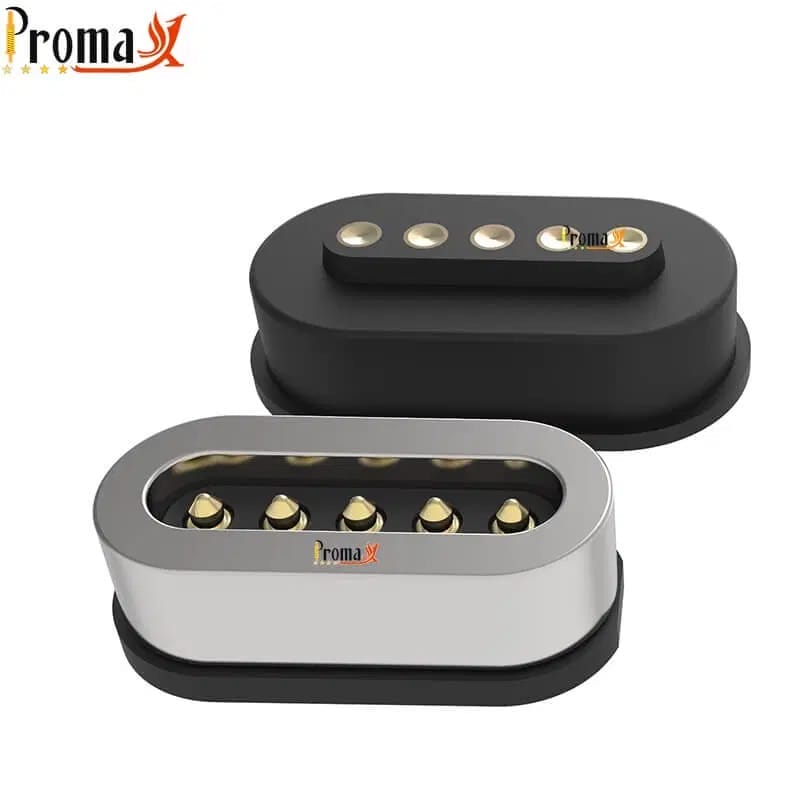
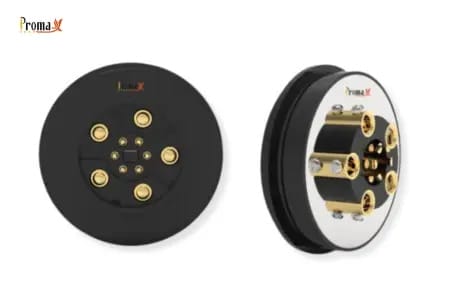
ISO 9001, ISO 14001, ISO 45001 e IECQ QC080000
 Más de 15 años de experiencia
 Muestras GRATUITAS para garantizar la satisfacción del producto
 Giro rápido: Producción en masa completa en 15 - 20 días
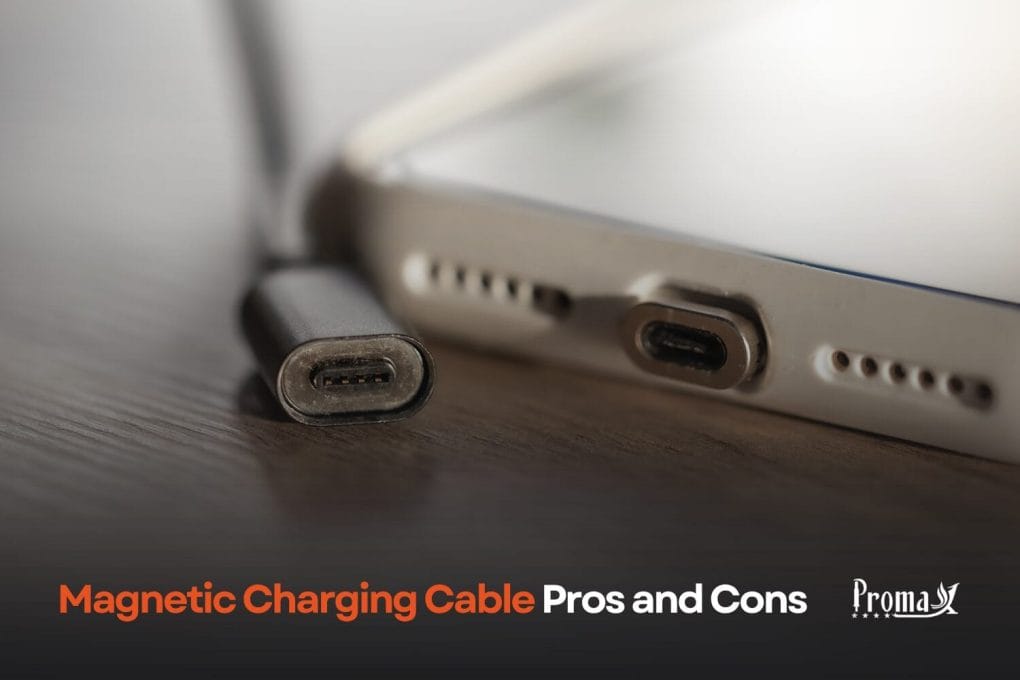
Over a device’s lifespan, its charging port can see thousands of insertion cycles. Every time you plug in a cable, the connector pushes against the port walls, wears down the contacts, and adds stress to the joint.
When you add up over thousands of charge cycles, that damage appears quickly. Magnetic charging cables were designed to solve this problem, but they introduce their own trade-offs. This guide covers the pros and cons of magnetic charging cables, explains how they work, and helps you figure out whether they’re the right fit for your device or product design.
How do Magnetic Chargers Work?
Magnetic charging cables work by separating the electrical connection from the mechanical plug-in action. There’s a small adapter that contains one or more spring-loaded pogo pins, and it sits permanently in your device’s charging port.
The cable end holds a matching magnetic collar. When you bring the cable close to the device, the magnets snap both pieces into alignment and hold them in contact. The pogo pins carry current across the interface.
Most consumer-grade magnetic cables use between one and five pins. A single-pin design handles basic power delivery. Two-pin and four-pin configurations add data transfer capability. Some higher-end cables include five or more pins to support fast-charging protocols and simultaneous data sync.
In well-designed connectors, the magnetic holding force is strong enough for normal charging use but low enough to disconnect under a sudden pull.
Magnetic Charging Cable Pros and Cons at a Glance
The table below compares magnetic charging cables against three common alternatives across the most important buyer decision factors.
| Característica | Magnetic Charging Cable | Traditional USB Cable | Wireless Charging | MagSafe |
|---|---|---|---|---|
| Connection method | Magnetic snap-on adapter + pogo pins | Direct plug-in for USB-C, Micro USB, Lightning | Inductive coil, no physical pins | Magnetic alignment + inductive coil |
| Charging speed | Up to 100W | Up to 240W | Up to ~15W | Up to 15W |
| Data transfer | Yes | Yes | No | No |
| Port wear protection | High — adapter stays in port | Low — repeated insertions | Full — no port contact | Full — no port contact |
| Accidental pull protection | Yes — magnet releases cleanly | No | Yes — device lifts off pad | Partial — device lifts off |
| Compatibility | USB-C, Micro USB, Lightning adapters | Universal per standard | Qi-enabled devices only | iPhone 12+ and MagSafe accessories |
| Ideal for | Frequent charging, high-cycle environments | High-speed data transfer and fast charging | Overnight charging convenience | Apple ecosystem users |
The Pros of Magnetic Charging Cables
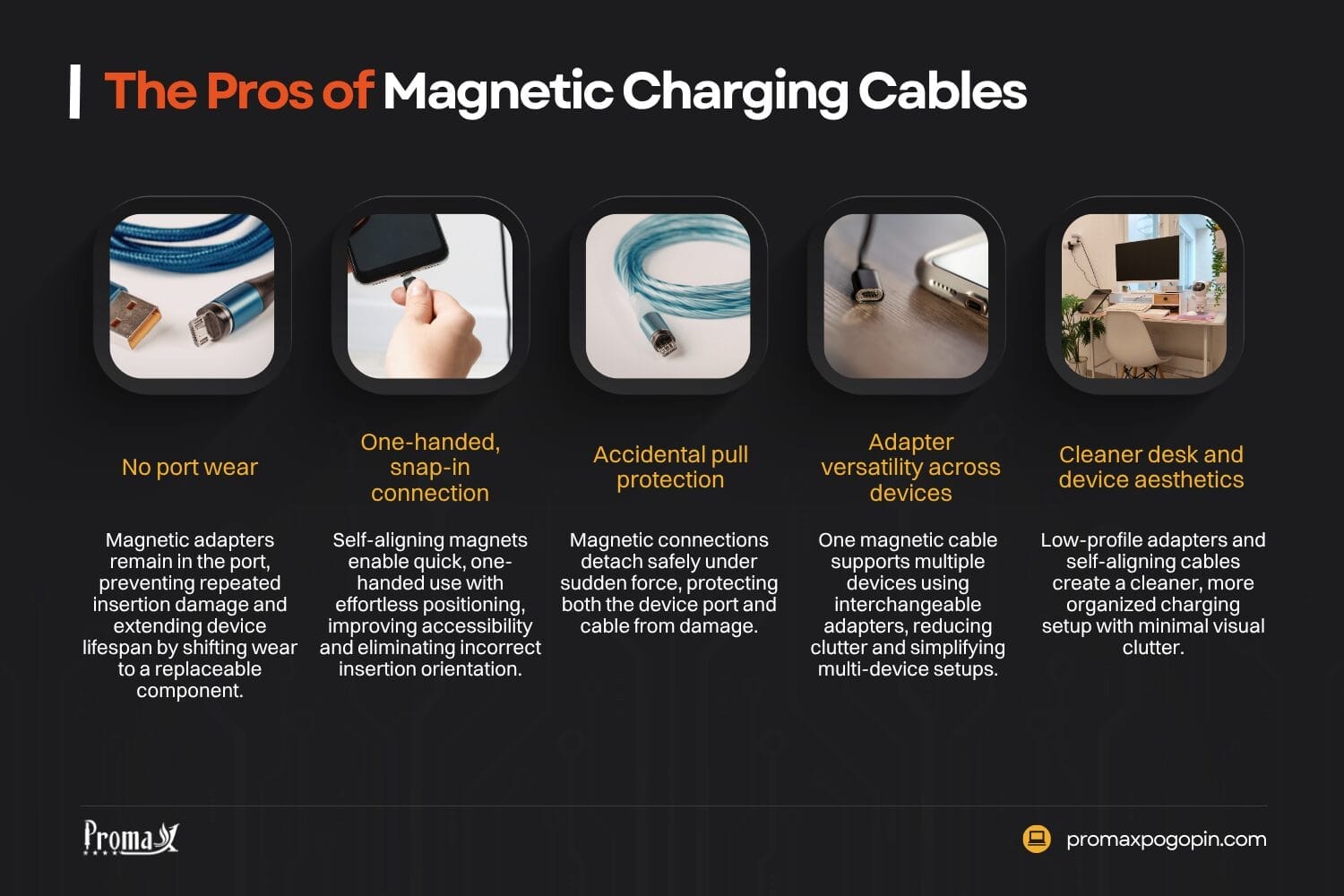
No port wear
With a magnetic cable, the permanent adapter sits in the port. The cable end only ever contacts the adapter and never the port itself. That means the port walls and internal contacts aren’t subjected to repeated insertion stress.
USB-C and Micro USB ports are rated for a finite number of insertion cycles. This is typically 10,000–30,000 for USB-C under IEC standards, and heavy users can exhaust that count faster than they’d expect.
Magnetic adapters shift the wear onto a replaceable component, effectively extending the life of the device.
One-handed snap-in connection
The self-aligning magnetic snap means you don’t need to look at the port. The cable finds its position automatically. This is a meaningful advantage in low-light environments, for users with limited dexterity, and in any application where one hand is occupied.
In product design terms, it also simplifies the user experience for consumer devices. The connection is repeatable and intuitive since there’s no ‘wrong side up’ problem.
Accidental pull protection
Traditional cables transfer any accidental yank force directly to the port. With a magnetic connection, a sudden pull detaches the cable cleanly, protecting both the port and the cable itself.
Adapter versatility across devices
A single magnetic cable paired with multiple adapters can serve USB-C, Micro USB, and Lightning devices. For a household or team managing several device types, this reduces clutter without compromising per-device compatibility.
Industrial and B2B applications benefit similarly. A standardized cable can be deployed across a mixed device fleet, with only the small adapter differing per device type.
Cleaner desk and device aesthetics
The magnetic adapter leaves almost no profile when the cable is disconnected. Combined with the self-aligning connection, you get a tidier charging setup with less cable management required.
The Cons of Magnetic Charging Cables
Lower maximum wattage than a direct USB cable
This is the most practical limitation to understand. Direct USB-C cables using the USB Power Delivery standard can now support up to 240W under USB-PD 3.1. Most magnetic cable connectors on the consumer market currently top out at 100W.
For smartphones, tablets, and earbuds, that limitation won’t matter. For high-power laptops, gaming devices, or EV-adjacent charging applications, it may.
The adapter stays in the port and can be lost
The small magnetic adapter lives in the charging port. If you swap cables frequently or lend your cable to someone else, the adapter can be forgotten, misplaced, or accidentally knocked out.
Contact pin sensitivity
The exposed pogo pins on the adapter are small and can collect dust, pocket lint, or moisture. A contaminated pin surface increases contact resistance and can reduce charging reliability. The fix is simple, but it’s a maintenance consideration that doesn’t exist with a sealed USB-C plug.
Quality magnetic connectors rated IP67 or IP68 address this with waterproof and dustproof designs. If environmental exposure is a concern in your use case, specify a waterproof variant.
Not universally supported for fast-charging protocols
Fast-charging protocols require negotiation between the charger and the device over the data pins. Some magnetic cable configurations, particularly single-pin or two-pin designs, don’t carry the data lines needed for full protocol negotiation. That drops the charging output to a standard 5W instead of the 65W or higher the device supports.
Before specifying a magnetic cable for a fast-charging application, verify that the cable’s pin count and design support the required protocol. Four-pin and five-pin magnetic connectors are typically needed for fast-charge and simultaneous data use.
¿Necesitas pines pogo rápido? Habla con un ingeniero
Obtenga una cotización personalizada, coincidencia de especificaciones y orientación de fabricación, sin ralentizar su proyecto.
- ISO 9001 / 14001 / 45001 + IECQ QC080000
- 15+ años de experiencia
- Muestras gratis
- Producción en masa en 15–20 días
Are Magnetic Chargers Safe?
Yes, with some context.
Wired magnetic charging cables are electrically similar to standard USB cables. The pogo pin contact carries current just as a conventional plug does. The magnetic force holding the connection doesn’t interfere with the electrical path.
That being said, a few practical safety considerations are worth noting:
- Moisture: Exposed metal pins in a wet environment can short. If the device or adapter gets wet, dry both before reconnecting. Waterproof magnetic connectors are available in IP67 and IP68 configurations for harsher environments.
- Heat: A properly rated magnetic cable should not generate abnormal heat. If the adapter or cable gets warm during charging, it may indicate a current mismatch between the cable’s rated amperage and the charger’s output.
- Certified vs. uncertified products: As with any charging accessory, the safety of a magnetic cable depends on the quality of the components. Cables compliant with RoHS and REACH standards offer significantly more reliability than low-cost, uncertified alternatives.
The key safety variable is product quality, not the magnetic mechanism itself.
Who Should Use a Magnetic Charging Cable?
Magnetic charging cables aren’t a universal replacement for standard USB cables. Whether they’re the right choice depends on your charging requirements, environment, and how the device will be used. Here’s a breakdown of where they perform well and where a direct-plug cable remains the better option:
Good fit
- Devices charged multiple times daily, e.g. smartphones, earbuds, wearables.
- Products where port longevity is a design priority.
- Medical devices and assistive technology where ease of connection matters.
- Industrial equipment in high-cycle environments.
Good fit with the right spec
- Laptops up to 100W charge rate.
- Fast-charging devices, provided you select a 4-pin or 5-pin connector that supports the required protocol.
Less suitable
- Devices requiring USB-PD above 100W.
- Applications where the small adapter may be regularly lost or where port swap is impractical.
- Ultra-high-speed data transfer applications where direct-plug cables remain more practical.
Should You Choose a Magnetic Charging Cable?
Magnetic charging cables make the most sense when port protection, easy alignment, and frequent charging matter more than maximum wattage or universal accessory support. They can reduce wear on the device port, make everyday charging easier, and improve safety in high-cycle use cases. The trade-off is that you need the right pin layout, current rating, and sealing level for the application.
If you’re evaluating a magnetic charging solution for a product rather than personal use, our team at Pin de Pogo Promax can help you match the connector design to your charging power, cycle-life target, and environmental requirements.
Our magnetic cable connectors use NdFeB N52 magnets with a mechanical mating force exceeding 400g, and each conector de pin pogo magnético is rated for up to 10,000 mating cycles. We also offer conectores magnéticos impermeables.
Share your design requirements and habla con nuestro equipo de ingeniería about the right magnetic connector approach for your application.
Magnetic Charging Cable Pros and Cons FAQs
Do magnetic charging cables work with all devices?
Magnetic charging cables work with many devices that use a USB-C, Micro USB, or Lightning port, provided you use the matching adapter tip.
Compatibility depends on the adapter, not the cable itself. Check that the adapter supports your device’s charging protocol before purchasing.
Can a magnetic cable charge as fast as a standard cable?
For many charging applications up to 100W, a well-designed magnetic cable can deliver charging speeds close to a direct wired connection. Beyond 100W, direct USB-C cables with full USB-PD 3.1 support are the better option. For most smartphones and tablets, the difference is not noticeable in practice since they typically charge at 18W–65W.
How long do magnetic cable adapters last?
Quality magnetic adapters are rated for up to 10,000 mating cycles. At two connections per day, that’s roughly 13 years of rated life. The limiting factor in real-world use is usually physical damage or loss, not electrical wear.
Is it safe to leave the magnetic adapter in the port?
Yes, the adapter is designed to sit in the port continuously, and it protects the port from direct plug-in stress. Just keep the exposed pins clean and dry. If you’re using the device in a dusty or wet environment, a waterproof-rated adapter is the appropriate choice.
Do magnetic chargers interfere with NFC or wireless functions?
Consumer-grade NdFeB magnets in these connectors are small and operate at field strengths that don’t disrupt NFC, Bluetooth, or Wi-Fi. In normal consumer use, interference with NFC, Bluetooth, or Wi-Fi is not usually a primary concern, but final performance still depends on device layout and magnet placement.
Volver al principio: Cable de Carga Magnética Ventajas y Desventajas
¿Necesitas pines pogo rápido? Habla con un ingeniero
Obtenga una cotización personalizada, coincidencia de especificaciones y orientación de fabricación, sin ralentizar su proyecto.
- ISO 9001 / 14001 / 45001 + IECQ QC080000
- 15+ años de experiencia
- Muestras gratis
- Producción en masa en 15–20 días